

When you hear that "the state takes X% of your salary", check the denominator. Employee deductions are measured against gross salary, while the tax wedge is measured against total employer cost. The calculation uses the July 2026 rules and the same type of employment contract for every benchmark.
Short answer for the standard scenario
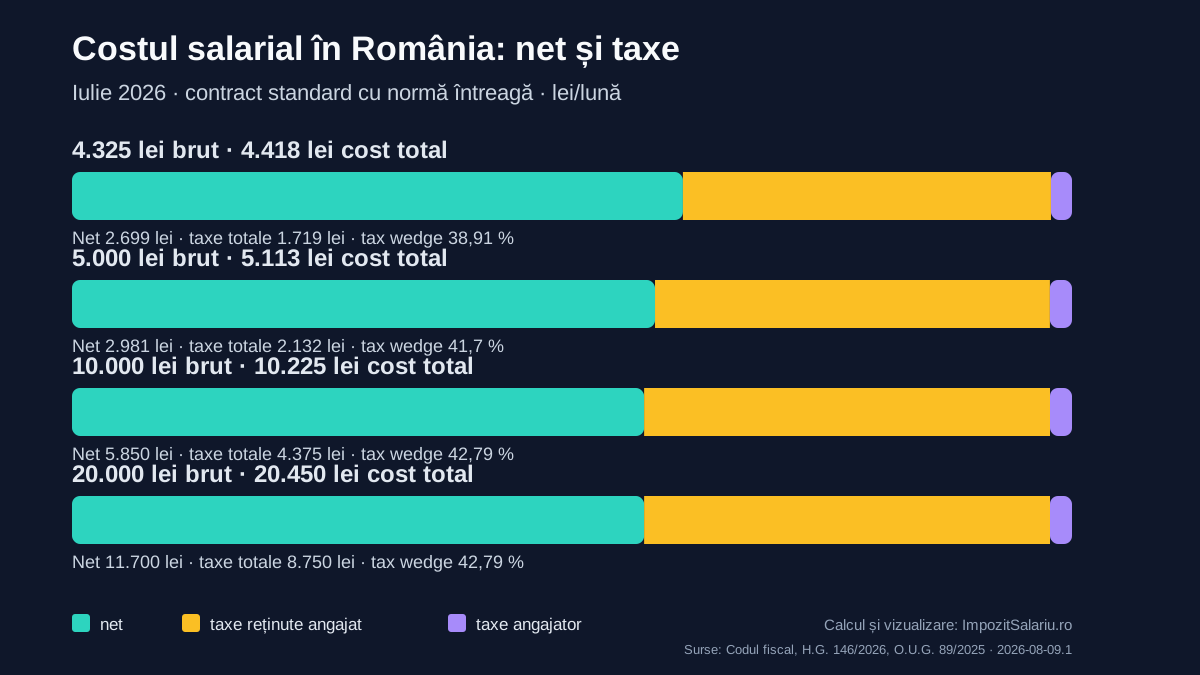
At a gross salary of 10,000 lei , the employee receives 5,850 lei, while total employer cost is 10,225 lei. Employee deductions and employer taxes total 4,375 lei, or 42.79% of total cost.
The scenario uses July 2026, a full-time main job, with no dependants, eligible children, meal vouchers or other reliefs.
What the three percentages measure
CAS is the pension contribution, and CASS is the health insurance contribution.
Deductions / gross = (CAS + CASS + income tax) / gross salary
Tax wedge / cost = (employee deductions + employer taxes) / total cost
Net share = net salary / total cost
Gross salary is the amount stated in the employment contract. Total cost adds the taxes owed by the employer, and the net share is what remains for the employee after deductions. A percentage of gross therefore cannot be compared directly with a percentage of total cost.
The same formula for four gross salaries
The table separates employee deductions from taxes paid by the employer. The deductions/gross column uses gross salary as its denominator, while tax wedge/cost uses total employer cost.
| Gross | Net | Employee deductions | Employer taxes | Total cost | Deductions / gross | Tax wedge / cost |
|---|---|---|---|---|---|---|
| 4,325 lei | 2,699 lei | 1,626 lei | 93 lei | 4,418 lei | 37.60% | 38.91% |
| 5,000 lei | 2,981 lei | 2,019 lei | 113 lei | 5,113 lei | 40.38% | 41.70% |
| 10,000 lei | 5,850 lei | 4,150 lei | 225 lei | 10,225 lei | 41.50% | 42.79% |
| 20,000 lei | 11,700 lei | 8,300 lei | 450 lei | 20,450 lei | 41.50% | 42.79% |
At 4,325 lei gross, the tax-free amount and personal deduction raise the net share to 61.09% of employer cost. At 10,000 and 20,000 lei gross, once those reductions are exhausted, the tax wedge is 42.79%.
- Employee net pay
- 5,850 lei (57.21% of cost)
- Taxes withheld from gross
- 4,150 lei (41.50% of gross)
- Taxes paid by employer
- 225 lei
- Tax wedge
- 4,375 lei (42.79% of cost)
Table alternative: every transition between tax bands
Each row compares two consecutive gross values. The first pair captures the loss of minimum-wage relief; the others preserve transitions between the personal deduction's 50 lei bands.
| Gross pair | Net before | Net after | Net difference | Rule |
|---|---|---|---|---|
| 4,325 and 4,326 lei | 2,699 lei | 2,614 lei | -85 lei | Leaving the 200 lei relief and entering the first deduction band |
| 4,375 and 4,376 lei | 2,643 lei | 2,642 lei | -1 lei | Entering a new 50 lei personal deduction band |
| 4,425 and 4,426 lei | 2,671 lei | 2,668 lei | -3 lei | Entering a new 50 lei personal deduction band |
| 4,475 and 4,476 lei | 2,697 lei | 2,696 lei | -1 lei | Entering a new 50 lei personal deduction band |
| 4,525 and 4,526 lei | 2,725 lei | 2,723 lei | -2 lei | Entering a new 50 lei personal deduction band |
| 4,575 and 4,576 lei | 2,751 lei | 2,750 lei | -1 lei | Entering a new 50 lei personal deduction band |
| 4,625 and 4,626 lei | 2,779 lei | 2,777 lei | -2 lei | Entering a new 50 lei personal deduction band |
| 4,675 and 4,676 lei | 2,806 lei | 2,804 lei | -2 lei | Entering a new 50 lei personal deduction band |
| 4,725 and 4,726 lei | 2,833 lei | 2,831 lei | -2 lei | Entering a new 50 lei personal deduction band |
| 4,775 and 4,776 lei | 2,860 lei | 2,858 lei | -2 lei | Entering a new 50 lei personal deduction band |
| 4,825 and 4,826 lei | 2,887 lei | 2,885 lei | -2 lei | Entering a new 50 lei personal deduction band |
| 4,875 and 4,876 lei | 2,914 lei | 2,913 lei | -1 lei | Entering a new 50 lei personal deduction band |
| 4,925 and 4,926 lei | 2,941 lei | 2,939 lei | -2 lei | Entering a new 50 lei personal deduction band |
| 4,975 and 4,976 lei | 2,968 lei | 2,967 lei | -1 lei | Entering a new 50 lei personal deduction band |
| 5,025 and 5,026 lei | 2,996 lei | 2,993 lei | -3 lei | Entering a new 50 lei personal deduction band |
| 5,075 and 5,076 lei | 3,022 lei | 3,021 lei | -1 lei | Entering a new 50 lei personal deduction band |
| 5,125 and 5,126 lei | 3,050 lei | 3,048 lei | -2 lei | Entering a new 50 lei personal deduction band |
| 5,175 and 5,176 lei | 3,076 lei | 3,075 lei | -1 lei | Entering a new 50 lei personal deduction band |
| 5,225 and 5,226 lei | 3,104 lei | 3,102 lei | -2 lei | Entering a new 50 lei personal deduction band |
| 5,275 and 5,276 lei | 3,131 lei | 3,129 lei | -2 lei | Entering a new 50 lei personal deduction band |
| 5,325 and 5,326 lei | 3,158 lei | 3,156 lei | -2 lei | Entering a new 50 lei personal deduction band |
| 5,375 and 5,376 lei | 3,185 lei | 3,183 lei | -2 lei | Entering a new 50 lei personal deduction band |
| 5,425 and 5,426 lei | 3,212 lei | 3,210 lei | -2 lei | Entering a new 50 lei personal deduction band |
| 5,475 and 5,476 lei | 3,239 lei | 3,238 lei | -1 lei | Entering a new 50 lei personal deduction band |
| 5,525 and 5,526 lei | 3,266 lei | 3,264 lei | -2 lei | Entering a new 50 lei personal deduction band |
| 5,575 and 5,576 lei | 3,293 lei | 3,292 lei | -1 lei | Entering a new 50 lei personal deduction band |
| 5,625 and 5,626 lei | 3,321 lei | 3,318 lei | -3 lei | Entering a new 50 lei personal deduction band |
| 5,675 and 5,676 lei | 3,347 lei | 3,346 lei | -1 lei | Entering a new 50 lei personal deduction band |
| 5,725 and 5,726 lei | 3,375 lei | 3,373 lei | -2 lei | Entering a new 50 lei personal deduction band |
| 5,775 and 5,776 lei | 3,401 lei | 3,400 lei | -1 lei | Entering a new 50 lei personal deduction band |
| 5,825 and 5,826 lei | 3,429 lei | 3,427 lei | -2 lei | Entering a new 50 lei personal deduction band |
| 5,875 and 5,876 lei | 3,456 lei | 3,454 lei | -2 lei | Entering a new 50 lei personal deduction band |
| 5,925 and 5,926 lei | 3,483 lei | 3,481 lei | -2 lei | Entering a new 50 lei personal deduction band |
| 5,975 and 5,976 lei | 3,510 lei | 3,509 lei | -1 lei | Entering a new 50 lei personal deduction band |
| 6,025 and 6,026 lei | 3,537 lei | 3,535 lei | -2 lei | Entering a new 50 lei personal deduction band |
| 6,075 and 6,076 lei | 3,564 lei | 3,563 lei | -1 lei | Entering a new 50 lei personal deduction band |
| 6,125 and 6,126 lei | 3,592 lei | 3,589 lei | -3 lei | Entering a new 50 lei personal deduction band |
| 6,175 and 6,176 lei | 3,618 lei | 3,617 lei | -1 lei | Entering a new 50 lei personal deduction band |
| 6,225 and 6,226 lei | 3,646 lei | 3,644 lei | -2 lei | Entering a new 50 lei personal deduction band |
| 6,275 and 6,276 lei | 3,672 lei | 3,671 lei | -1 lei | Entering a new 50 lei personal deduction band |
Methodology, data and reuse
- Period
- 2026-07 (rules applicable from 1 July 2026)
- Verified on
- Dataset version
- 2026-08-09.1
Scenario: Full-time main job with no dependants, eligible children, meal vouchers or personal tax reliefs.
- the contractual base salary equals the gross salary analysed
- zero dependants and zero eligible children
- no meal vouchers or income-tax exemption
- the employee does not claim the additional deduction for people under 26
- minimum-wage relief applies only when the tax engine confirms every condition
Download data and charts
Sources
- Government Decision no. 146/2026: minimum wage from 1 July 2026 (accessed 2026-08-09)
- Emergency Ordinance no. 89/2025: the 2026 tax-free amount and ceiling (accessed 2026-08-09)
- Consolidated Fiscal Code: CAS, CASS, income tax and CAM (accessed 2026-08-09)
- OECD: tax wedge definition and Taxing Wages methodology (accessed 2026-08-09)
Suggested attribution: Calculation and visualisation: ImpozitSalariu.ro, 'Salary taxation in Romania', version 2026-08-09.1, https://www.impozitsalariu.ro/en/articles/salary-taxation-romania
You may reuse the original charts and calculations with this attribution, without changing the period or scenario. The material is not published under CC BY 4.0, and this permission does not extend rights over cited legislation or third-party data.
The tax engine, order of operations and rounding rules are described in the calculator methodology.
How to read the tax map
The bar treats total employer cost as the whole. The net segment shows what the employee receives, while the other two segments separate deductions from gross salary from taxes paid directly by the employer. Use the table for exact figures; the chart shows proportions.
The tax share is not identical at every salary level. At the lower end, minimum-wage tax relief and the personal deduction affect the result. Once the personal deduction is exhausted, the proportions settle for the standard scenario, subject to small differences caused by rounding each liability to the nearest leu.
The interactive chart includes every 50 lei transition used by the personal deduction and consecutive values around each threshold. Sudden changes are therefore not smoothed away by a series drawn from a handful of convenient points.
Why the percentage changes with salary
The denominator comes first. Employee deductions divided by gross salary answer: "How much is withheld from the contractual salary?" Total taxes divided by employer cost answer a different question: "What share of employment cost does not reach the employee as net pay?"
The employee's circumstances and contract also matter. Main-job status, dependants, eligible children, age, meal vouchers, income-tax exemption and minimum-wage relief can change the result. Part-time employment requires a separate calculation, especially when the minimum contribution base applies.
For your own case, start with the salary calculator and keep the month, gross salary and contract options consistent. The methodology page explains rounding and the limits of the tax engine.
When the figure can be compared with OECD data
The OECD defines the tax wedge as the difference between the employer's labour cost and the employee's net take-home pay, expressed as a percentage of labour cost. The calculation may include income tax, employee and employer social contributions, payroll taxes and relevant cash transfers for the household analysed.
OECD rankings use standardised scenarios tied to average earnings and household composition. Compare the Romanian benchmark with OECD data only when the period, salary level and household match. This guide therefore uses the OECD definition without publishing a ranking based on a different scenario.
For a comparison built with the same household and relative income levels across member states, see the 2025 EU labour tax burden ranking. That page separates income tax and contributions, and its table shows how Romania's position changes at 67%, 100% and 167% of national average earnings.
Reusing the figures and charts
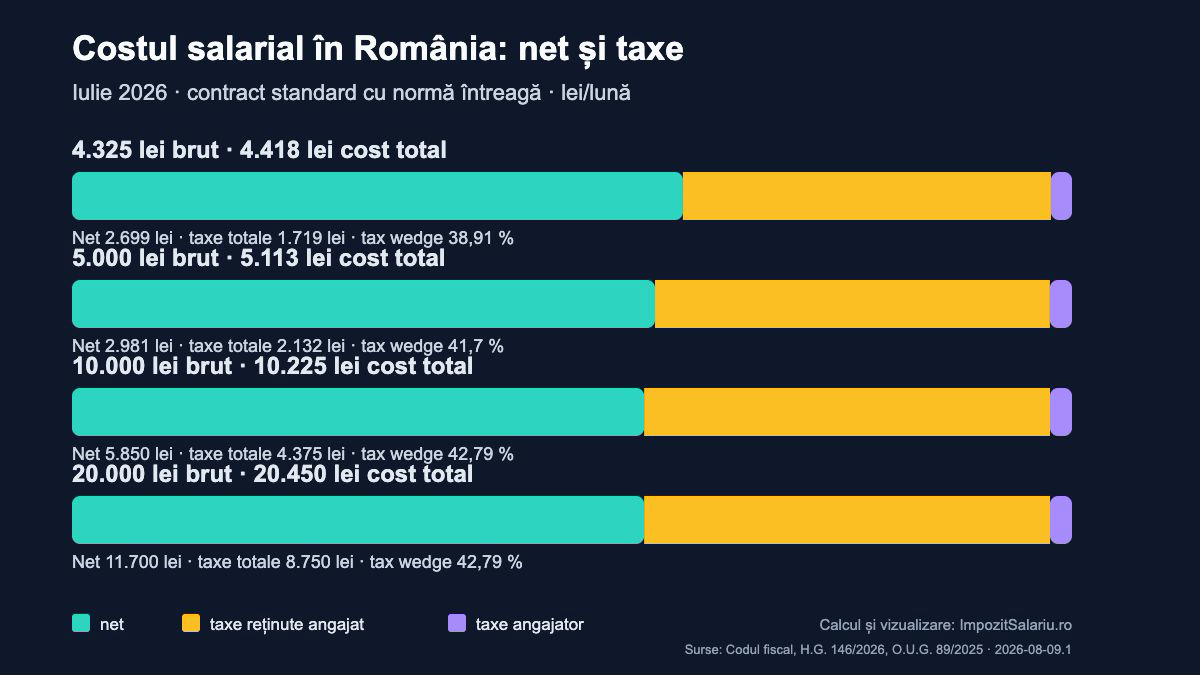
The CSV contains every point used in the visualisation, including the period, unit, scenario, sources and dataset version. The press chart uses the same benchmarks and includes attribution within the image. When citing a figure, preserve at least the tax period, scenario and percentage denominator.
Original ImpozitSalariu.ro files may be reused under the terms shown in the methodology section. Legislation and third-party data remain subject to their own terms; our permission does not change their legal status.