

The year 2018 brought major changes to Romanian payroll law. Emergency Ordinance no. 79/2017, which amended Law no. 227/2015 on the Fiscal Code, transferred the health insurance contribution (CASS) and social insurance contribution (CAS) to employees. The employer's only remaining contribution was the 2.25% work insurance contribution.
What did transferring CAS and CASS to employees mean?
The payment process changed little for employees: they did not have to pay these contributions to the tax authority themselves. Employers continued to withhold and pay them when paying salaries.
Gross salaries increased after these changes, but net salaries did not rise as much as many people expected. In some cases, net pay fell compared with 2017.
To help employees retain the same net salary, the state introduced a negotiation requirement involving an addendum to the individual employment contract. Negotiations were expected to finish by the end of 2017, while employers had until 31 March 2018 to report the changes in Revisal.
In practice, negotiation could secure a higher gross salary, but employers were not required to raise gross pay enough to preserve or increase each employee's 2017 net salary.
How could you calculate your gross salary for 2018?
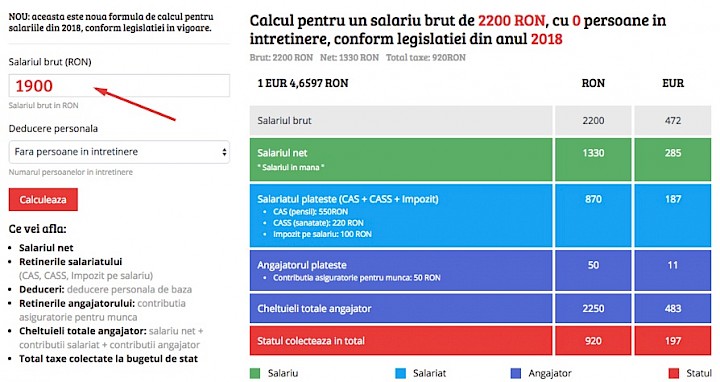
To find the gross salary you needed in 2018 to retain your 2017 net pay, use the 2018 salary calculator. Enter your 2017 gross salary to see what you would have earned in 2018.
If the resulting net salary is too low, use the net-to-gross calculator. Enter the net salary you want, and the calculator will return the gross amount to negotiate with your employer.
Both calculators account for personal deductions for employees with dependants. Select the number of dependants and the calculator will handle the rest. You can also find a printable payslip at the bottom of the page.
We hope these tools helped you negotiate your salary correctly for 2018.